Contents
Read while on holiday in September 2026. In general I was surprised at how long this was. I think Pope Leo could have aimed for a shorter, punchier piece on perhaps just some of the topics he covers here. I know many have observed that there is a general trend of papal encyclicals becoming longer and longer, but this does seem like a good example.
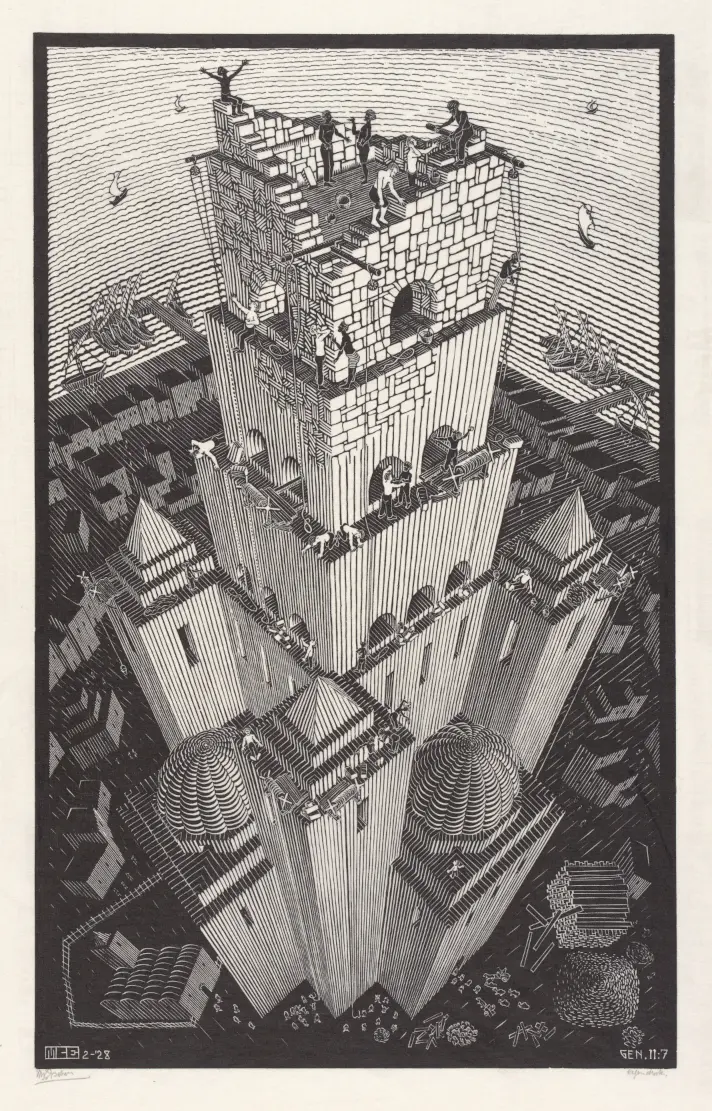
I think he does really well in here to point out the evils of what he calls the “technocratic paradigm” and posthumanism. I did expect this to be more spiritual essay than socio-political. There is the overarching Biblical analogy of the Tower of Babel vs. Nehemias’ rebuilding the walls of Jerusalem that he comes back to. There is some reflection on St. Augustine’s two cities as is fitting. There are other more spiritual parts. But I felt these were a bit tacked on to a more worldly essay that sometimes felt like it was written for non-Christians. Maybe it was.
Introduction
Our choice today is whether to construct a new Tower of Babel, a city that aims to seize superhumanity for itself without God, or a city where God and man dwell together and man exceeds what is possible under its own efforts through God’s grace.
Building for the common good
With the common good in mind, humanity’s weaknesses and limits are not errors to be corrected. We desire “fullness of life”, and technology today is often deceitfully presented as the solution to the human condition.
All too often, we place our hope in unlimited “upgrades,” in forms of progress that exacerbate inequalities, and in immediate solutions incapable of healing people’s wounds.
He will quote J.R.R. Tolkien later in the letter, but I am reminded here of the downfall of Númenor, Tolkien’s Atlantis and Babel, when the Númenoreans attempt to make war on the gods, exceed their natural limits, and seize eternal life for themselves.
Remaining human
This might be the central message of Magnifica humanitas:
In the era of artificial intelligence, when human dignity is threatened by new forms of dehumanization, ours is the pressing duty to remain profoundly human.
He asks, are we losing sight of the proper relationship between man and technology (typified best by AI today), and is the current direction of technological advancement currently stripping us of our humanity?
Chapter One: A Dynamic Approach Faithful to the Gospel
A Church journeying through human history
Social Doctrine as a shared discernment
In this encyclical, Pope Leo wants to draw attention to the Church’s social doctrine as a “process of shared discernment”. We should be taking our time to use these broad doctrinal principles to discern what technological changes mean and how we should be reacting to them.
The fruitful tension between the universality of the Church’s mission and her local roots is an intrinsic aspect of her life.
Here he is talking about how the Church’s social doctrine is not a single set of rules that will apply to all places and times, but I think this is a very good general point, and reminds me of Fr. Aidan Nichol’s thoughts on “bi-culturalism” (as opposed to multi-culturalism) in The Realm. The Church does not have a single cultural face, but exists (or should exist) in all places and times as a “bi-cultural” or “inculturated” entity, incorporating the best of local culture into herself.
Chapter Two: Foundations and Principles of the Social Doctrine of the Church
The principles of Social Doctrine
The principle of the unerversal destination of goods
The Church’s tradition acknowledges the existence of private property but also sees property as “a means of protecting and managing goods so that they may better serve the common good.” Pope Leo argues that new types of property, patents, algorithms, techonological infrastructure, and data, should be also be subject to the common good.
The principle of subsidiarity
Decisions should be made at the closest level possible to the people involved.
Chapter Three: Technology and Dominance. The Grandeur of Humanity in Light of the Promises of AI
The technocratic paradigm and digital power
The “technocratic paradigm” is the making of economic and social decisions with a view to maximizing profit and efficiency. In this paradigm creation and human beings themselves are just cogs in the machine, things to be used and made more efficient. To put words into the Pope’s mouth, it’s the Faustian, cyberpunk dystopia that was predicted decades ago. It’s truly here among us, and it’s not that sexy. AI and other burgeoning technologies have greatly furthered the technocracy in recent years. The Pope is saying that they are not evil in themselves and could be used to do great good, but because they are so powerful, they require new ethics, new policies, and above all discernment.
Romano Guardini, from Das Ende der Neuzeit:
Contemporary man has not been trained to use power well.
St. Paul VI:
The most extraordinary scientific progress, the most astounding technical feats and the most amazing economic growth, unless accompanied by authentic moral and social progress, will in the long run go against man.
The result of technological advancement without corresponding ethical advancement will be:
an increase in means without a growth in humanity: “having more” without “being more.”
Artificial intelligence
This “intelligence” is not the intelligence of human beings.
So-called artificial intelligences do not undergo experiences, do not possess a body, do not feel joy or pain, do not mature through relationships and do not know from within what love, work, friendship or responsibility mean. Nor do they have a moral conscience, since they do not judge good and evil, grasp the ultimate meaning of situations, or bear responsibility for consequences.
Their “learning” is not our learning. They are not shaped by a life, they do not:
grow over time through their choices, mistakes, forgiveness and fidelity.
A valuable tool that requires vigilance
There are dangers inherent in so powerful a tool. With speed and simplicity they can deliver information and analysis, but excessive reliance on them could weaken personal creativity and judgement.
We should be aware that their responses also reflect the cultural assumptions of those who trained them.
There is also the illusion of being a real person:
Here, the danger is not so much that a person may believe they are communicating with another person, but rather that they may gradually lose the very desire to form genuine human connections.
Responsibility, transparency and the governance of AI
Calling for prudence, rigorous evaluation and even, at times, a slower pace in adopting AI does not mean opposing progress; instead, it is an exercise of responsible care for the human family.
It is also not enough to demand that AIs be given morals, we must insist on a further condition:
the possibility of openly discussing the ethical frameworks involved and subjecting them to shared standards of social justice.
Regarding the management of data, Pope Leo argues that since it is the product of many contributors it is not something to be held, or bought, or sold by a select few. Creative solutions are needed to manage it as a common good.
He also calls for the “disarming” of AI, not merely in the military context, though that is part of it. It is also ending the “arms race” of ever more powerful datasets and algorithms for both geopolitical and commercial dominance. Technical power does not confer the right to govern. Technology should not dominate humanity.
To those who develop AIs, Pope Leo has this message:
In one sense, technological innovation can represent human participation in the divine act of creation. Developers, therefore, bear a particular ethical and spiritual responsibility, for every design choice reflects a vision of humanity. Just as the creator of an artistic or literary work must consider the values it conveys, so developers are called to embed values in their projects with due seriousness: with transparency, responsibility toward affected communities and careful attention to ensuring that what is being cultivated is a genuine good.
What must not be lost
“Fullness of life” in the “technocratic paradigm” means having more material stuff, eliminating weakness and inefficiency, and having total control. Human beings are something to be optimized, rather than persons.
Technical power, if left unbalanced, does not make us more capable; it makes us more isolated and more vulnerable to being dominated and excluded.
I wasn’t 100% sure what he meant by this last point, but the context seems to be that different human faculties, like intelligence and τέχνη, must be balanced like species in an ecosystem. It is dangerous to maximize one to the detriment of other faculties, it doesn’t serve the human being. I would have liked him to expand on this a bit more.
The quality of a civilization is measured not by the power of its means, but by the care it is able to offer, by its ability to recognize the other as a face not merely as a function.
This is one of the places where I thought he was being a bit worldly, a bit unspiritual. Surely he should have said that the quality of a civilization is measured by the extent to which it in the first place loves the Lord God with its whole heart, soul, and mind, and then in the second place loves its neighbour as itself.
Underlying narratives: transhumanism and posthumanism
I thought it was really good for the Pope to explicitly draw attention to the underlying narratives. There are powerful people in the world attempting to use technology to surpass humanity, and they do not see all human life as having value.
The limit, the heart, and the grandeur of the human person
The Holy Father has a great opening to this section:
Our relationship with life seems to be in crisis today. Everything that appears as a “limit” — incapacity, illness, old age, suffering, vulnerability — tends to be seen primarily as a defect to be corrected, rather than as a reality through which our humanity matures and opens itself to relationship.
The Christian perspective however is to recognize the “contingency” of all things. Nothing in this world is self-sufficient, all things are finite and depend on something else for their existence. This “limit” is entirely natural and is no defect to be corrected. Rather it is through encountering our own weakness, our own failure, that we can gain real wisdom, and have true encounters with other persons and with God.
Even when limitations are experienced as inner suffering, human wisdom teaches us not to deny or suppress it, but to integrate it. To eliminate suffering entirely would mean, in the end, extinguishing love and desire as well.
The world is proposing a kind of theosis by using technology to eliminate suffering. Even if it could do that we would find that something essential about being human had been lost. Christianity proposes theosis through suffering.
The authentic “more than human”: grace and Christian humanism
The “more than human” is in fact part of the Christian tradition, but it is not achieved through technology but rather through grace in Christ. This theosis is not an escape from our nature but a fulfilling of it.
Two cities and two loves
St. John Paul II, in his first encyclical Redemptor hominis (1979), posed a key question of any technological progress:
[Does it] make human life on earth “more human” in every aspect of that life? Does it make it more worthy of man?
Chapter Four: Safeguarding Humanity at a Time of Transformation. Truth, Work, Freedom
Truth as a common good
Truth and democracy
Tech companies wield enormous power today. They influence people’s beliefs about the nature of humanity, the family, our purpose, and even God himself. Their power is entirely detached from truth. They believe that they can shape reality.
Benedict XVI, in Caritas in veritate:
Modern man is wrongly convinced that he is the sole author of himself, his life and society. This is a presumption that follows from being selfishly closed in upon himself.
Pope Leo in this section and elsewhere in the encyclical seems to be assuming that democracy is the best form of government and that the reader will naturally agree with this. It is a bit tiresome, but I think he is perhaps he is both showing his age and his nationality. Makes me think of the recent suspension from teaching of Fr. Edmund Waldstein. One theologian defending the suspension said rather confidently:
Integralist positions clearly contradict Catholic teaching and the legal framework of a democratic constitutional state.
Communication and the collective imagination
Communication is not only the transmission of information, but it is also the creation of a culture.
I like this remark of the Pope’s. It seems reminiscent of Marshall McLuhan’s “The medium is the message”. The message is not the only part of communication, rather the communication itself and its medium do something to us, often without us realizing. Digital communication has created and is creating a culture. That virtual world is not entirely virtual. It has come to be a huge part of our lives today.
The central role of schools
He mentions a few different challenges facing schools today, but the one that caught my attention was concerning knowledge and fragmentation. This is actually a bit frightening to think about:
Without careful attention, an educational system lacking in a love for truth may emerge, in which an incessant flow of information replaces the essential exercise of research, reflection and discernment. As knowledge becomes increasingly fragmented, it becomes difficult to grasp reality as a whole, to ask profound questions about meaning, or to develop authentic, critical and creative thought. Many educators already report signs of dehumanization, where people may “know many things” but struggle to find direction in their lives, partly due to an inability to connect information with deeper knowledge or maintain a sense of purpose. A genuinely healthy attitude is needed, requiring rhythms that incorporate silence, in-depth study, reading and judicious analysis, for without these elements inner freedom may be compromised.
The dignity of work at a time of digital transition
The value of work
I found this comment interesting, but would have liked more detail or examples:
The need to keep up with the pace of technology can erode workers’ sense of agency and stifle the innovative abilities they are expected to bring to their work.
The problem of unemployment
The Pope argues that automation and AI cannot just be dropped on the workforce willy-nilly. Measures must be taken in advance to protect and retrain workers so that all can benefit from the changes and no one is simply disposable.
Protecting freedom against dependencies and commercialization
Dependencies and societal control
“Digital sobriety”! What a great phrase. Technology must strengthen our freedom, encourage us to use it soberly, and protect the vulnerable, not exploit them.
All of our actions online are recorded. Whatever we view, buy, like, dislike, etc. Those who control this data have the ability to profile, predict, and influence us, without our knowledge. We must be on guard against the technocratic paradigm and posthumanism, i.e. those who would use this data to maximize efficiency and profit while exploiting the vulnerable, those they deem “second-class” humans.
Chapter Five: The Culture of Power and the Civilization of Love
The culture of power
The normalization of war
The Pope points out that in recent years there has been a real and troubling shift in public discourse towards war and rearmament. I would personally argue that Pope Leo is showing his age here again. The post-WWII peace that to his generation seemed so natural and secure has proved to be in fact somewhat fragile, since it was based on assumptions (e.g. about liberalism, democracy, globalization, religion, the Church, etc.) that are proving false. Not that I am not also worried when I hear of wars and rumours of wars. But it doesn’t surprise me that we are reverting back to an earlier, more bellicose state.
I remember hearing about this passage when the encyclical first came out:
Today, more than ever, without prejudice to the right to self-defense in the strictest sense, it is important to reaffirm that the “just war” theory, which has all too often been used to justify any kind of war, is now outdated. Humanity possesses far more effective and capable tools for promoting human life and resolving conflicts, such as dialogue, diplomacy and forgiveness. The use of force, violence and weapons reflects a relational poverty that always has disastrous consequences for civilian populations.
I think because the destructive power of our military technology is so great today, we do need to reconsider carefully what kind of war could be just, but Pope Leo seems a bit too dismissive of Just War Theory, as if it had nothing to contribute to the discussion today. It’s in the Catechism, so it can’t be that outdated!
Force without limits
Pope Leo rightly draws attention to the military-industrial complex and huge economic incentives it has for fomenting war.
He praises the Treaty on the Prohibition of Nuclear Weapons, but notes that no nuclear-armed state has signed it.
The crisis of multilateralism
The era of economic globalization that succeeded the Cold War was supposed to bring peace and unity, but instead globalization has “provoked fundamentalist, identity-based and nationalistic reactions”.
A supposed political realism
Peace is neither a naïve hope nor merely the absence of war; instead it is always possible as the fruit of justice and charity.
Building the civilization of love
We can all do our part
Pope Leo quotes Gandalf (The Return of the King, Book 5, Chapter 9, “The Last Debate”):
It is not our part to master all the tides of the world, but to do what is in us for the succour of those years wherein we are set, uprooting the evil in the fields that we know, so that those who live after may have clean earth to till.
Building peace through justice
He thinks about St. Augustine’s commentary on Psalm 84: 11, “Justice and peace have kissed”:
There is no one who shuns the desire for peace, yet not everyone is willing to practice justice… But perform the works of justice, keeping in mind that justice and peace have embraced; they are not at odds with one another.
Peace is a fruit of practising justice. We must put in the difficult work of justice and resisting sins against justice if we are to have peace.
Conclusion
The Word became flesh
The technocracy and posthumanism promise us a fuller life without weakenss and suffering. But the living God has already descended into history:
He takes upon himself our weakness and transforms it into a setting for salvation.
The construction site of our time
We must consider the digital world as a new continent to be evangelized, one that requires generous missionaries who are mature in the faith.
Furthermore, helping children to grow up to use technology responsibly, helping them recognize risks and make sound choices, is a form of charity.
Although the digital culture does provide social interaction, human beings still need genuine, physical closeness:
I invite everyone to cherish places and times where physical presence remains crucial, such as shared meals, Christian community gatherings, time spent with the lonely and serving the poor.