Contents
Read in Lent, 2026. It was originally published in 2008, not long before I came to live in England.
He discusses various literary figures as critics of the culture dominant in England today including J. R. R. Tolkien and T. S Eliot, but also someone I hadn’t heard of before, the poet and painter David Jones. I would now quite like to read his The Anathemata, as well as T. S. Eliot’s The Waste Land, and G. K. Chesterton’s The Everlasting Man.
Chapter 1: The Conversion of England
What is the cause?
- p. 17, the reason for the decline of the Church in England is apathy (not dissent as some Tablet writers may claim), apathy towards religion
The debate about England
- p. 21, in a footnote discussing the Christian monarchy vs. the vague republican sentiments of English elites today, he notes that the pro-EU lawyer Neil MacCormick laments the EU’s lack of:
a single individual, elected or chosen by some reasonable process, who, in a significant sense, personifies or bears the overall persona of the Union
Dialogue and mission
- p. 27, Fr. Nichols was hostilely interviewed by the BBC’s “Sunday Programme” in 1999, regarding the Conversion of England, and wouldn’t that mean eliminating any other religions, and wouldn’t that be a bad thing?
- sed contra if what the Catholic Faith gives is Divine Revelation in human form, namely the highest good, truth, and beauty there is, the all elements of goodness, truth, and beauty found in those other religions would attain their fulfillment, their crown
Realism or fantasy?
- pp. 28, 29, the original Conversion of England involved Anglo-Saxons like Wilfrid, Cuthbert, and Chad, but also the Italian Augustine, the Greek Theodore of Tarsus, and the Irish Aidan
- missions need eyes both on the inside of the culture and outside
- those inside may not be best placed to judge what the culture’s christening requires
- those outside may not have sufficient sympathy for the culture or identity with its members to change hearts and minds
- p. 30, on immigration
- race is not what should count, but desire to have a common home
- immigrants should come with a willingness to enter into their new home’s distinctive culture, at minimum learn its language
- The Catholic Church in England has this bipolar nature, this synthesis of native and immigrant, that should be to its advantage
- The Church of England is too native, the Eastern Orthodox too foreign
The need for a mission policy
- p. 31, from his book Christendom Awake, Fr. Nichols gives a list of policies he thinks necessary to turning the Church around, including:
- “a re-enchanting of the Liturgy, so that by language, gesture, image, music, it brings before us the transcendent beauty of the Kingdom of God”
- renewing Christian political thought, showing the proper way to combine order and spontaneity in a civil life under God
- renewing the family by uniting wherever possible home and work, the domestic and the economic
- in my case COVID has unexpectedly done that to some extent, though this may not be exactly what Fr. imagined, remote-working in a tech job
- resacralizing art and architecture which should be “echoes of the divine order beyond the world as well as of the meaning we make within it”
- recovering a Catholic reading of the Bible
- p. 33, on church schools:
- cites James Arthur, a researcher then at Christ Church Canterbury, and critic of how church schools function today
- church schools need leaders who inspire pupils and lead them in prayer, who take religion to be central in the life of the school, who can expound the philosophy of Christian education, and are senitive to both justice and charity
A provisional conclusion
- p. 34, the Church must create a culture:
A full-blooded catholicity with the power to fascinate and draw individual people to itself and transform a culture in all its principal dimensions. That is what the ‘mission to convert’ and ’the conversion of England’ mean to me.
Chapter 2: Albion
Origins
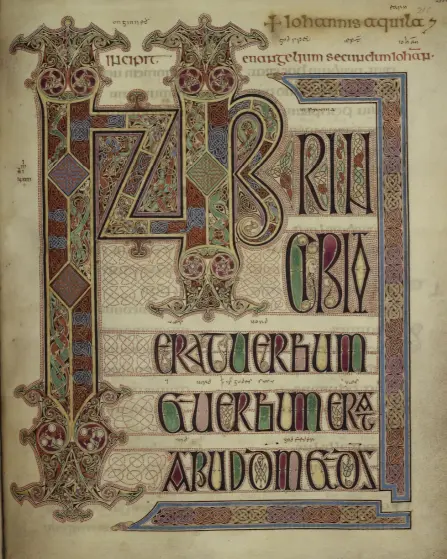
- p. 35–37, the Lindisfarne Gospels are an “icon of the genesis of a nation”
- a visual equivalent of Bede’s Historia Ecclesiastica, a fully integrated image of an emergent nation formed from different cultural groups
- according to Michelle B. Brown they came from a time:
notable for its ability to merge elements from the Celtic, Germanic, Graeco-Roman, and Christian Orient cultures to give birth to a new order in Europe: the early Middle Ages.
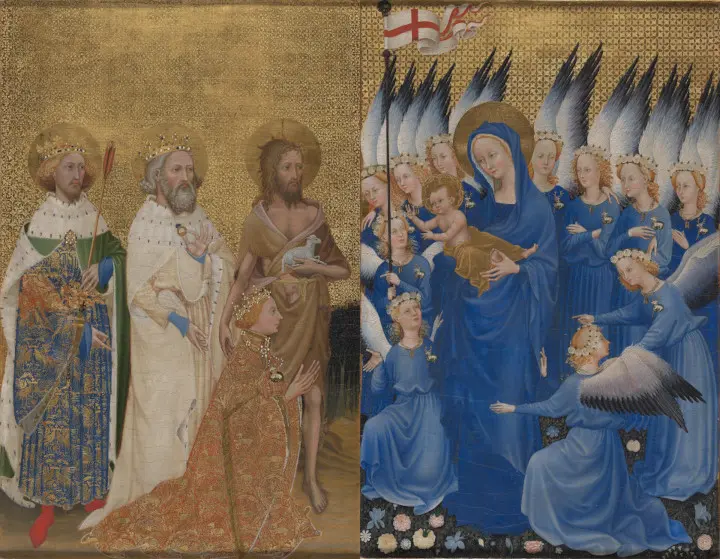
- p. 155, also worth considering England as Our Lady’s “especial dower”, which Richard II command Archbishop Thomas Arundel of Canterbury to announce at Lambeth in 1399
Law: from covenant to correctness
- p. 39, the two laws, common law (Anglo-Saxon) and civil law (Roman, taught in the medieval universities), interact and may be complementary
- p. 41, internationalism and imposed multiculturalism (as opposed to the bi-culturalism proposed in Ch. 1) are destroying national self-determination and democratic accountability (considered goods even under classical Liberalism)
- p. 42, the law must also promote the good, not just punish injustice
- Romans xiii, 3, 4: “For princes are not a terror to the good work, but to the evil. Wilt thou then not be afraid of the power? Do that which is good: and thou shalt have praise from the same. For he is God’s minister to thee, for good. But if thou do that which is evil, fear: for he beareth not the sword in vain. For he is God’s minister: an avenger to execute wrath upon him that doth evil.”
- 1 Peter ii, 14: “Be ye subject to governors as sent by him for the punishment of evildoers, and for the praise of the good.”
Parliament: from council of the wise to party contest
- p. 51, the House of Lords as a “social house”, not a revolution but an evolution
- The House of Commons represent individuals by territory
- The House of Lords could become something that represents communities, which is closer to the medieval idea of Parliament
- Anglican bishops and hereditary peers would sit comfortably alongside representatives of employers, unions, cities, professions, and other religions.
- There should be Catholic voices, not necessarily episcopal
- The modern innovation of life peers was not merely intended as a way to reward politicians, it was meant to bring people from different walks of life who has distinguished themselves somehow into the House of Lords
The Church: from Catholic to chimaera
- p. 59, footnote directing readers to Peter Nockles’ The Oxford Movement in Context
Law, crown, Parliament and Church at the end of teh ‘ancien régime’
- p. 63, England had an ancien régime that came to an end, but unlike in France, it did not suffer a total revolution, it “left intact much of its form and substance”. There was a kind of break however, which I think is perhaps the dominance of liberalism, “political modernity”, and the industrial revolution:
Nonetheless, through it all the ancien régime survived as a recognisable Christendom society, albeit one distorted by the Erastian mould. As the above paragraphs on the Church indicate, the end of the English ancien régime is dateable to the opening decades of the nineteenth century. (Paradoxically, Catholic Emancipation, itself driven by anxiety over Ireland, was key to the emergence of the new settlement.)
- p. 65, Edmund Burke’s Reflections on the Revolution in France:
Society … is not a partnership for things subservient only to the gross animal existence of a temporary and perishable nature. It is a partnership in all science; a partnership in all art; a partnership in every virtue, and inall perfection. As the end of such a partnership cannot be obtained in many generations, it becomes a partnership not only between those who are living, but between those who are living, those who are dead, and those who are to be born.
- p. 66, the French Revolution caused politics and history, previously the realm of the few, to invade the everyday lives of the many
- George Steiner, Aspects of Counter-Revolution:
What the French Revolution has done is to abolish the mellennial barriers between common life and the enormities of the historical. Past the hedge and gate of even the humblest garden march the bayonets of political ideology and historical conflict.
p. 67, even England faces this reality today, the increasing bureaucracy of the Nanny State
Chapter 3: The Needs of the Nation
An objective common good
- p. 73, post-war Christian democracy: obligatory devotion to the publicly celebrated democratic faith, with voluntary devotion to the publicly ignored and socially disrespectable religious faith; this has obvious consequences
- p. 74, England today, with on the one hand a scientific elite careless of ethics, and on the other an increasingly vocal radical Islam, demonstrate what a “neutral” democracy entails
- p. 75, David Marquand, a political scientist:
- Britain became a pioneer, breaking more decisively than other nations from the “Old Society”, undergoing a cultural revolution which enabled the Industrial Revolution
- p. 76, the de-establishment of the Church of England ought to be concerning to Catholics too
- According to Edward Norman, it would be the deconsecration of the nation itself:
From confessing a higher purpose for human society, even in a very residual manner, to regarding its members only as subjects of policing and material welfare, is a very serious matter.
Chapter 4: Critics of the Culture
Eliot, Coleridge, Arnold
- p. 82, parallel between T. S. Eliot’s opposition to Communism and Samuel Taylor Coleridge’s to Jacobinism
- both thought that virtue and happiness were not to be attained merely by selecting the right form of government
- both thought that the revitalization of Christian thought and culture in England required a Christian intelligentsia, Coleridge’s “clerisy”, an educated religious body with a public vocation, a new “first estate”
- p. 84, tradition fosters the individual and his or her talent
- p. 85, Coleridge felt that catechesis, shaped by the Church, was necessary to prevent private interpretation of Scripture
- p. 87, Eliot and Matthew Arnold both sought a stronger elite class, not for its own sake, but in order to benefit all of society
- Eliot wanted families to be intergenerational (> 3 generations), pointing to both past and future:
Unless this reverence for past and future is cultivated in the home, it can never be more than a verbal convention in the community.
- p. 88, Eliot on elites:
[A] growing weakness of our culture has been the increasing isolation of elites from each other, so that the political, the philosophical, the artistic, the scientific, are separated to the great loss of each of them.
- p. 89, a critic, R. V. Young, on Eliot’s The Waste Land:
Although the poem seemed to be an attack upon respectable Christian society, it was in reality a lament, and a cry of alarm, over the deliquescence of the civilization of the West: falling into a comfortable materialism, devoid of all authentic Christianity, and with only a sterile respectability left behind. Despite its “modernist” techniques, … the poem implies a prophetic denunciation of the secularism, rationalism, and materialism characteristic of the modern era. The Waste Land is thus the most notable instance of radically innovative, “modernist” art in the service of tradition.
- the underlying structure of The Waste Land is mythic, despite all modernist appearances/texture
- it is from Eliot’s pre-Christian period
- the references are oblique, but point to traditional sources of wisdom: Arthurian legend, Dante, the Gospels, the Old Testament prophets, St. Augustine, Virgil, the Buddha
- my own thoughts on The Waste Land
Eliot, Maritain, Maurras
- p. 90, Eliot owed much to the early Jacques Maritain (not so much the later), especially in the view that:
Religion saves poetry from the absurdity of believing itself destined to transfoorm ethics and life: saves it from overweening arrogance.
- p. 92, Charles Maurras’ reading of French history after the Revolution:
- revolution and liberalism had led to the atomization of intellectuals
- free intellectuals still existed, but in an environment dominated by the press, and behind the press, high finance
- p. 94, Eliot: the experiment of civilization without Christ will fail, but not immediately:
The experiment will fail, but we must be very patient in awaiting its collapse; meanwhile redeeming the time: so that the Fiath may be preserved alive through the dark ages before us, to renew and rebuild civilization, and save the world from suicide.
- p. 95, Eliot believed that a society should have a common religion to whatever degree possible, this is the context for his remarks on the undesirability of free-thinking Jews
- on the other hand he commented on how desirable it would be to have close contact between practising Christians and Jews (as opposed to Christians and Jews untethered from their respective traditions)
David Jones
- p. 97, we should pay attention to the “ecology of cultures”: England benefits greatly from influences from Scotland, Wales, and Ireland
- p. 98, David Jones thought a lot about the contemplation of form
- form in art: the “parts united in one” that we see in works of art may be as close as we can get in this world to the proportions of the Heavenly City
- form in history: there is some providential design in history, not least in “the matter of Britain” (subject of his book-length poem The Anathemata)
- the pre-historical and historical events that formed Britain are best recalled in the context of sacred time, i.e. “the time of the Mass whose unfolding gives [The Anathemata] its basic context and even structure”
- p. 100, Jones’ two chief themes:
- recollection, ἀνάμνησις
- sacrament or efficacious sign
- the Eucharist is the centre of The Anathemata’s “orbiting images”, it is “the great Symbol”
- p. 103, man is a sacramental animal, the most primitive marks made on surfaces by man are not simply utilitarian, but symbolic, they show again under another form, they recall something
- p. 105: genuine myth conserves but also makes present:
To conserve, to develop, to bring together, to make significant for the present what the past holds, without dilution or any deleting, but rather by understanding and transubstantiating the material, this is the function of genuine myth, neither pedantic nor popularising, not indifferent to scholarship, not antiquarian, but saying always, “Of these thou hast given me I have lost none”.
Christopher Dawson
- p. 107, religion/reason/thought elevate human culture above animal culture
- p. 108, every religion entails a whole attitude to life and conception of reality; if you change something here it brings about a change in the whole culture
- p. 109, a religion is not just an ideology, since it looks beyond this world, beyond the finite world of the state and the economy
- Apostolic Majesty on Christopher Dawson
G. K. Chesterton
- p. 110, both Chesterton and David Jones were received into the Catholic Church by Fr. John O’Connor of St. Cuthbert’s, Bradford, who was the insipiration for the detective Father Brown
- Jones’ theology of history as given in The Anathemata is akin to Chesterton’s in The Everlasting Man: a hermeneutic in which Christ and his Crucifixion is the the pivotal person and event in history
- Christianity allowed these men to “limit the scope of historical subjects while expanding their substance”
- p. 111, Chesterton was “a passionate union of imagination and intellectuality”
- to feel both at home in the world and yet astonished by it is vital for us
- Christianity nurtures and educates us in these two attitudes
- Christiantiy legitimizes these attitudes by its doctrines, showing how they fit with reality at large
- famiiliarity and yet astonishment should be our basic response to life, our very thinking, our emotions, our analysis, our understanding of the world
- when putting the finishing touches on this philosophy, Chesterton suddently realized that it was indistinguishable from Christian orthodoxy, from the worldview of the Church, hence his Orthodoxy
- p. 114, his four key propositions of orthodoxy:
- the world does not explain itself
- there is something personal in the world, as in a work of art
- despite its odd design, its purpose is beautiful
- the correct form of giving thanks for this is humility and restraint
- the world could easily have not existed, or taken a form very different from this one, or contained a very different ecology of species
- p. 117, certain behaviours like mercy and justice or chastity and procreativity could be seen as antagonistic, but to most people their combination derives from common sense
- moral syntheses like these ultimately come from the “moral atmosphere of the Incarnation”; without the Incarnation they would not have been apparent
- the mysteries of Christianity enable us to keep combinations of virtues and yet observe each virtue in its integrity
J. R. R. Tolkien
- p. 119, “Tolkien was seeking, the in the name of a ‘good’ paganism, a mediating standpoint between Christian and non-Christian in his audience”
- The specifically Christian conviction in his work is that all will one day be turned to good, but it is not so yet nor seems likely to be soon
- The Resurrection is the eucatastrophe of the Incarnation which is itself the eucatastrophe of human history
- From On Fairy-Stories:
[I]n the “eucatastrophe” we see in a brief vision that the answer may be greater — it may be a for-off gleam or echo of evangelium in the real world.
- M. Sebanc, J. R. R. Tolkien: Lover of the Logos:
[The Lord of the Rings rose to] heights of mass popularity at the very moment in the mid 1960s when the Church was in the throes of making its cultic worship more “relevant” by shearing off from it the ordered, hieratic dimension of sacred play. For many orphaned souls, asphyxiated by the banality of modern life, Tolkien was opening a window to transcendence.
- We need mythopoeisis, the creation of secondary worlds that throw light on this world, divinely created, and to be summed up in Jesus Christ
Hilaire Belloc
- p. 122, Belloc was impatient as a historian, unwilling to spend long sifting through and comparing sources, though he was nonetheless endowed with great perceptiveness
Belloc has been called the wreck of a great historian.
- p. 123, Distributism:
- the means of production should be owned by the family unit
- trade is conducted between different family units under the umbrellas of guilds who control quality and fairness of pricing
- though Distributism came to nothing in his life, there are elements of it under re-construction by Catholic economists today
- Fr. Nichols cites John Médaille, The Vocation of Business. Social Justice in the Marketplace, 2007
Chapter 5: Integral Evangelisation
Introduction
- p. 126, evangelization is a daunting prospect at any time, but it is given particular urgency in our present cultural climate
- A. White, OP:
The society in which we live no longer seems to resound to the rhythms of divine grace, it has lost the religious habits of the heart and can no longer speak the language of religious tradition.
- p. 127, we may be entering what could be called “steady-state post-industrial society” (phrase from William Hutton)
- “The time will come and perhaps is closer than we think, when the limits of technology-induced change are in effect reached.”
- “The Middle-Ages with computers”
- There is little incentive in our consumerist society to fund massive experimental technology projects as their was in the Space Race of the 1960s
- 20 years after the time of writing we are in the midst of an AI bubble and it is to be seen how long that will last and what its effects will be
- And yet there may still be hope as Fr. Nichols suggests that if we develop the right evangelical strategies now, they will be of use for many years too come
- And yet our age isn’t really Medieval at all
- commercial advertisements and media personalities, etc., dominate our minds
- anomie prevails, the young arrive at adulthood without having internalized any duties or developed a sense of living under authority
- there’s a general unwillingness outside of the Islamic world to die for or even be inconvenienced for civilization-based ideals
- neighbourliness has disappeared, and people restrict their benevolence to those whom they love at the moment, or those from whom they stand to benefit economically
- dealing with one’s vices is much harder when society as a whole has lost any sense of a rightful ordering of the human world
- p. 130, thus “integral evangelization” is all the more urgent
- divine revelation is a resource that can correcct present errors and vices, can unmast our society’s ugliness
- more importantly revelation is also an invitation of deification
- we can’t use it as a practical solution to a problem at the expense of deification (the temptation of L’Action française)
- p. 131, Desmond Fennel’s “savvy”, meaning “prudent circumspection that scans the environment and takes everything into account”, and evangelization
- if the evangelized are well-disposed they feel gratitude, and greater trust and openness to the Gospel
- if ill-disposed, the unwelcome but perceptible truth disconcerts them, puts them less in control, makes their opposition to the Church less confident
The intellectual (prophetic) element
- p. 133, if religion is only sentimental it will not weather the storms of life
- it cannot represent Christianity as an all-embracing Idea, the Incarnation of the Word
- p. 134, Catholics need to be alert to contemporary culture, but also have a mature understanding of the Church’s dogmatic truth
- apologetics must be renewed, “taking advantage in the English-speaking world of the new school of apologists flourishing in the contemporary United States”
- Catholic professionals need to see themselves as members of a Catholic intelligentsia with a special mission to society
- for this they require a mature faith and the ability to articulate it
- p. 135, according to Orthodox priest Patrick Henry Reardon, philosophy is corrected by the Son and the Spirit, these give us orientation in philosophical discernment
- the Son come in the flesh redeems yet transforms the external, historical order
- the Spirit sent into our hearts (the seat of understanding) to transform the internal order of knowing and certitude
- cf. 1 Thess. i, 5: “ὅτι τὸ εὐαγγέλιον ἡμῶν οὐκ ἐγενήθη εἰς ὑμᾶς ἐν λόγῳ μόνον ἀλλὰ καὶ ἐν δυνάμει καὶ ἐν πνεύματι ἁγίῳ καὶ ἐν πληροφορίᾳ πολλῇ”
- p. 136, in St. Thomas Aquinas we have to hand a Christian philosophy that combines trust in the sense with trust in the mind
- “its capactiy to serve the Gospel is not yet exhausted”
- p. 137, Fr. Nichols thinks a pooling of the various theologies of the Church would be advantageous, bringing all their resources together to serve the Church
- we should work towards theological unity, taking into consideration Scripture read in Tradition, the Fathers, the Liturgies, the Councils, the sains, and the medieval and modern divines
The mystical (priestly) element
- p. 139, the heart of the mystical is the Liturgy, it is the template for prayer
- “a wondrous sacral home preparing us for the life of eternity — just as our domestic home is meant to prepare us for the life of time”
- p. 140, the most enduring features of Christian mysticism:
- the transience of the world and the glory of God
- the fleeting nature of fortune and the mercy of God
- the inevitability of tragedy and the victory of God (the fall -> eucatastrophe)
- the centrality of humility and the cognate humility of God
- p. 141, the Liturgy should impact on civil society, creating sacral times and spaces, holidays, processions, etc.
- church buildings are:
houses of God, where a rich patrimony of sacral music, art and architecture can assist the performance of rites and devotions that are themselves condensed forms of the mystical. All of these sensuous signs enable Christian mysticism to travel across the boundary between the inner and the outer world.
- p. 141, the Church’s greatest enemy today is its “own internal secularization”, the voluntary and unconcious adoption of the ideas of its enemies
- the Liturgy as generator of mysticism is the most powerful antidote to the problem of Church leaders’ enthusiasm for humanism as the core of Christianity
- the Church becomes indistinct from its environment, and people stray away from it
- the re-enchantment of the Liturgy, and full restoration of its sacral character is therefore vital
- p. 142, the mystical will always have appeal, because mankind will always be restless and dissatisfied with the transience of the world
- Baron Friedrich von Hügel: it is because human beings “have the dim, inarticulate sense of what the Abiding means that the mere slush of change is so sickening”
- when the Liturgy is celebrated sub specie aeternitatis, our evangelization is able to address our modern (and historical) heartsickness
The institional (kingly) element
- p. 145, the Church’s institutions will hamper evangelization unless there is some corporate spiritual atmosphere detectible at all levels
- not only in the presbytery, but on the administrator’s desk, in the scholar’s study, at the family’s dining table
- called by some Eastern Orthodox theologians “the Liturgy after the Liturgy”, i.e. every expression of the Church is a continuation of the Liturgy
- p. 146, the modern democratic State’s purpose is to encourage equality and self-determination of individuals while setting no upper limits on the extent of its own power
- to achieve this is must dissolve any traditional authority, be it clergy, local communities, or parents
Woe to that State which accepts the secution of the serpent in the garden, “Ye shall be as gods” and seeks to establish the “natural measures of good and evil”.
- p. 148, the specifically Christian aspect of our message to wider civil society should be theocentric humanism
- the issue of abortion as a litmus-test of true humanism
- the Incarnation as God’s elevation of humanity:
The divine prizing of humanity for which the Son died and the Spirit was poured out is the sign of God’s faithfulness to his original creative intent: human beings are made in his image and likeness.
- p. 149, the lay vocation is out in the world of this age, the creation that “groaneth and travaileth in pain, even till now”
- p. 150, in the first half of the 20th century there were various English lay Dominicans critics of technology
- what they criticized was not labour-saving devices in themselves, rather technology that promised something “superior to the human act”, technology that brought about habits in us inimical to the Gospel
- such technology becomes not just tools but what it never should be, “the measure of the human world”
- e.g the contraceptive pill profoundly alters the family, and in vitro fertilization enables the homosexual “family”
- “savvy” is again needed in discerning the effects of such technologies
Conclusion
- p. 151, the various elements of modern culture do not make a whole, the “sovereign territories of each field of endeavour do not converge on any horizon of meaning”
- our evangelization would offer a spiritual sybiosis, enabling a unity in society
Overall Conclusion
- p. 155, the Lindisfarne gospels are a fitting icon of how Christianity made this nation
- p. 156, if society is not to succumb completely to hedonism and actualy take on ethical demands, then the State must preserve its openness to divine revelation
- Jacques Maritain’s Christian democracy (Christian values with no reference to the transcendent) has failed
- the state should serve to guard moral and spiritual culture (exemplified by the Coronation Rite)
- T. Dilworth on David Jones’ The Anathemata:
Because at the Last Supper, on the cross, and in the Mass Jesus makes history of myth, he renews all this amassed tradition so that the cumulative maypole of human culture is no longer the barren “mortised stake” of merely remembered or imagined form. Spiritually and therefore ontologically, it blooms. If this is always true within the Mass and especially at the moment of sacramental transformation, which is the poem’s fictional context, it is also potentially true for the reader, for groups of people, and for our civilization.